Category Archives: Blog

COMOM 2017 – Free Annual Dental Clinic

Dental professionals seeing patients at COMOM

2017 COMOM Dental Clinic

This past weekend, Colorado Mission of Mercy held its annual free dental clinic, this year in Pueblo, Colorado. I volunteer at this clinic when I’m in town, but unfortunately, I was out of state this year. Luckily, we had several staff members – and a dog – who did a good job representing our office. Along with 200 dentists, 120+ hygienists, and countless other volunteers, they had a very rewarding weekend. We don’t know the final numbers yet, but it looks like over 1700 dental procedures were performed.

COMOM Mission

From the COMOM website, its mission is as follows:

The Colorado Mission of Mercy (COMOM) provides quality dental services, at no cost, to individuals of all ages who cannot afford and access dental care; eliminating dental pain, promoting oral health, creating smiles, and providing oral health education.

COMOM 2017, Pueblo, Colorado

Susan holding a portable x-ray unit

Susan at COMOM 2017

Almost every staff member has volunteered at COMOM in one capacity or another. This year, Susan, Lee Ann and Jane attended. Susan is not holding a ray gun, that’s a portable x-ray unit! She spent all day Friday (and I mean all day) taking x-rays of patients once they were seen in the triage area.

Lee Ann explaining findings to a patient.

Lee Ann, 2017 COMOM

Lee Ann helped with oral cancer screenings.  The good news is that she only saw one patient with a suspicious lesion in their mouth.  Here, she is relaying her findings to a patient and explaining next steps.

Jane took on a different role this year and served as co-lead for all 120+ hygienists. She attended planning meetings, helped set up, organize, and tear down hygiene stations, and made sure hygienists had everything they needed. Some days, she arrived at 5:00 a.m. and didn’t leave until 7:00 p.m.  Near the end of the last day, with 70 patients still waiting to have their teeth cleaned, she even rounded up a few dentists to help work through the back log.

Therapy Dogs at COMOM

Lee Ann, Jane and Indy at the 2017 COMOM dental clinic

Lee Ann and Jane posing with Indy

Carla usually stays home with the dog when I volunteer, but had the idea last year that therapy dogs would be a good fit with COMOM. Often times, patients camp out over night to save a place in line. Once inside, they wait to be triaged, wait for x-rays, and then wait for whatever procedure they are going to have done. In other words, a lot of waiting. Carla and I have both gone through the Go Team therapy dog training with Indy, seeing first hand the positive reactions he receives.  Therefore, Carla started talking with COMOM coordinators early this year about having therapy dogs visit with waiting patients, and they agreed to have Indy come on a test basis.

Therapy dog Indy getting petted by kids

Indy getting petted by kids

What a hit he was! Hundreds of patients gave him hours of non-stop affection. Carla and Indy started outside, greeting patients as they were waiting in line to come in. Then they came inside and worked the waiting areas where people he’d met outside would call for him to come over for another round of petting. The volunteers also found Indy to be a good stress reliever.  As a result, Carla was asked if she could get more Go Team dogs/handlers there for the Saturday clinic. Because there’s a Go Team in Pueblo, she was able to get three more dogs and handlers to come and visit patients and volunteers on very late notice.

Indy Visits Waiting Patients

Indy Visits Waiting Patients

Indy Visiting With Patients

Indy and the Old Man

COMOM in Greely, 2018

Next year’s event will be held in Greeley, CO. This is such a rewarding opportunity for us, you can be sure our office will be represented again.
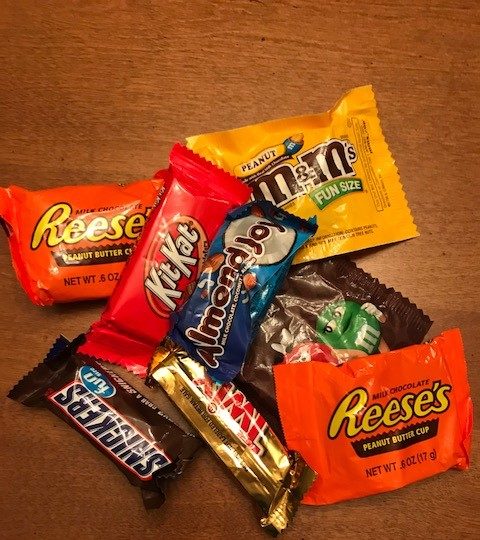

Be Smart About Halloween Candy

Halloween Candy

Halloween candyIt’s that time of year – Halloween is just around the corner. As a parent or as someone giving out candy, what do you need to know?

Candy Harmful To Teeth

We’re not sure that there’s such a thing as candy that’s good for your teeth. Why?  Because sugar in candy interacts with bacteria normally present in your mouth to produce an acid byproduct. This byproduct can weaken a tooth’s enamel, the hard protective covering surrounding the tooth. When enamel is damaged, cavities can start to form. That said, some candies are definitely worse for your teeth than others. They include:

  • Sticky or Chewy Candy. These include candies such as taffy or caramel, which tend to stick to your teeth. The longer candy stays on your teeth, the longer the acid byproducts have to wear away tooth enamel.
  • Sour or Acidic Candy. These include candies specifically labeled as “sour” and also an old favorite, lemon drops. Because these candies are both acidic and sugary, you get a double whammy effect. They also tend to be candies that are in the mouth for extended periods of time as they dissolve, thus bathing the teeth in sugar.
  • Hard Candy. Years ago, a patient had a Jolly Rancher in his mouth, bit down, and when he opened his mouth, the candy stuck to his crown and pulled it off. Just this week, a new patient came to our office because he bit down on a piece of candy and broke off a piece of his tooth. (This tooth had filling in it, meaning it was already compromised.) Similar to the sour or acidic candies, many hard candies are meant to be slowly dissolved in your mouth over a period of time, thus giving the sugar more time to bath the teeth, interact with bacteria, and produce acid that is harmful to the teeth.
  • Pop Corn Balls. Who hasn’t eaten a popcorn ball and had part of it stuck in their teeth? And, they are sugar filled and sticky.

Better Candy Options

There is some good news regarding Halloween candy. Chocolate is actually a good choice because it dissolves from your teeth pretty quickly. Dark chocolate is better than lighter chocolates as it contains less sugar.

Do You Need To Avoid Halloween Candy?

No. Halloween is a fun holiday for kids and families. When your kids come home with those bags of candy, though, make sure they are practicing good oral health. In other words, make sure they brush and floss before they go to bed.  For additional information, see  “Halloween Candy: Your Dental Health Survival Guide” at Mouth Healthy, a website maintained by the American Dental Association (ADA), and a Reader’s Digest article titled “Top 5 Worst Halloween Candy for Your Teeth, According to Dentists.”

Rubber Dam – An Important Dental Tool

Not every dentist uses a rubber dam when performing dental procedures on patients. Not all patients understand what rubber dams are or why they are used. In fact, I had a patient in the office yesterday who recently transferred from another office.  She had no idea what I was doing when I started preparing the rubber dam for placement in her mouth. I hope that by the time you finish reading this blog post, you understand why I think they are an important tool in our office.

Rubber Dam Description

A patient with a rubber dam isolating their teeth

A rubber dam applied over a patient’s mouth

This photo shows a patient with a rubber dam in place. We take a 5×5 or 6×6 sheet of latex or nitrile (non-latex) material and place it over the tooth or teeth to be worked on. Holes are punched in the material.  We then use floss to work the material in between each tooth to be worked on. A clamp is placed on the most rear tooth to hold the material down, and a napkin is then placed between dam and the skin. As you can see in the photo, we then attach the edges of the dam to a metal frame to hold it in place.

Why Don’t All Dentists Use Rubber Dams?

Dentists are trained (not very well I might add) how to use rubber dams in dental school. Like many others, when I first graduated from dental school, I thought they were too cumbersome and time-consuming to use on a regular basis.

When I started participating in my first study club, however, the mentor of our club showed us younger dentists how to properly place a rubber dam.  Finally, I understood that they can be placed efficiently and effectively. From that point, I began using rubber dams consistently with my patients.

Why Should Rubber Dams Be Used?

If I am placing a small filling towards the front of the mouth, I may not use a rubber dam. However, any time I am working on a tooth towards the back of the mouth, I use a rubber dam. I use it to isolate the quadrant of the mouth that I am working on. In my opinion, the main advantages to using a dental dam are:

  • Visibility – I see nothing but the section of the teeth I am working on.
  • It creates a clean, dry field for me to do my work.
  • There is no contamination of the field with saliva. This is particularly important with tooth colored fillings, which are technique sensitive.  Saliva can compromise the bonding process of the composite material to the remaining tooth.
  • The patient does not swallow any old fillings (if we are removing old restorations) or water from the hand pieces.
  • It protects the soft tissue of the tongue and cheeks and keeps them out of the way.
  • When performing root canals, the rubber dam provides protection to the cheeks and tongue from the rinse we use (usually bleach) when cleaning out the tooth canals.
  • Small files are used during root canals. A rubber dams ensures that a dropped file does not enter a patient’s throat.

Rubber dams do require some additional time to place. However, when I look at time spent to do this and weigh it against the increased protection for my patients, patient safety wins.  Furthermore, when I consider the ability it gives me to do better work, it’s pretty clear.  The benefits of using rubber dams far outweigh any disadvantages.


Fluoride Helps Prevent Cavities

Benefits of Fluoride

Today’s Gazette Telegraph includes an editorial from the Sun Sentinel in Fort Lauderdale, Florida. Titled “Fluoride’s Benefits are Settled,” the article brings up an important point about dental health. Decades of scientific research shows fluoride helps prevent cavities and is safe in the amounts usually present in drinking water.

ADA Position On Fluoridated Water

From the American Dental Association (ADA) website: “More than 70 years of scientific research has consistently shown that an optimal level of fluoride in community water is safe and effective in preventing tooth decay by at least 25% in both children and adults. Simply by drinking water, Americans can benefit from fluoride’s cavity protection whether they are at home, work or school. The Centers for Disease Control and Prevention named community water fluoridation one of 10 great public health achievements of the 20th century.”

The ADA website also provides interesting information regarding fluoridated water.  The optimal level of fluoride in the water is 0.7mg/L . By comparison, this equates to 1 inch in 23 miles, or 1 minute in 1000 days, or 1cent in $14,000. A small amount of fluoride packs a big punch in terms of preventing cavities.  This is why you see the ADA supporting the use of fluoridated water.

Naturally Occurring Fluoridated Water

Fluoride is naturally present in Colorado Springs’ water supply. In the past, several areas of town had too much fluoride present their water supplies, causing fluorosis, a condition characterized by white spots or a brown stain on teeth. This brochure from Colorado Springs Utilities notes that currently, all water in the City meets EPA standards regarding safe amounts.

Personal Experience Shows Fluoride Helps Prevent Cavities

I see the benefits of fluoridated water every week when kids come into our office with no cavities.  Furthermore, my opinion about the benefits of drinking fluoridated water was reinforced on mission trips we took to the Dominican Republic and Kenya. In the Dominican Republic, we saw water without fluoride and kids with easy access to sugar cane. Sadly, and predictably, we saw rampant decay of their teeth. In Kenya, an area which has naturally occurring fluoride in the water, we saw significantly less decay when we treated kids. While the diet there did play a part in their dental health, it also shows that fluoride helps prevent cavities.

Should You Brush Your Teeth? Yes, But….

Should you brush your teeth?

As a practicing dentist of 30 years, the answer from me is a definite yes. But, that comes with some qualifications in terms of scientific data, brushing that is actually harmful to your teeth, and other things besides brushing that can help you maintain healthy teeth.

I receive regular emails from the American Dental Association (ADA), including one that “compiles news stories from a wide range of sources” to keep dentists up-to-date on what seems to be of interest to the general public. Today’s email included a link to a Reader’s Digest article with this interesting title: “This is the Most Efficient Way to Keep Your Teeth Clean – Without Brushing Them.”

Reader’s Digest Article

I would encourage you to read the article because it contains interesting information about good dental care for you and your family. It is not a surprise that this article claims the best way to keep your teeth healthy is to avoid eating sugar. It explains why this is the case, but also goes further and gives information about foods that can promote healthy teeth.

Good foods include those that are alkaline instead of acidic, which help keep the pH levels in your mouth at a higher level, which is healthier for your teeth. On the flip side, foods that are too acidic can cause lower pH levels, which doesn’t promote good oral health.

How To Brush Your Teeth

The other important point of this article touches on proper brushing technique, or how to brush your teeth. Some patients think the harder they brush or floss, the better. What they don’t know, though, is that flossing that is done too vigorously can harm your gums. They also don’t understand that brushing too hard can actually harm tooth enamel, especially when used with some toothpastes. Almost all toothpaste includes some type of abrasive material to help with the cleaning process. Teeth whitening toothpastes tend to include a lot of this material. If you use them (we typically don’t recommend) and brush too hard, it can really cause damage to both tooth enamel and gums.

In our practice, we can also tell that some patients don’t brush their teeth long enough. We encourage our patients to invest in electric tooth brushes as they are timed for the right amount of brushing and they also help avoid problems from brushing too hard because they alert you if too much pressure is being used. There are several good brands on the market, and different staff members use different ones, but we do sell one brand in our office, at our cost, for patients of record. The better your home care, the less likely you will need to see us for fillings or other restorative services. Prevention is key!

Contact Us

Mark T. Albers, D.D.S.
2155 Hollowbrook Drive
Suite 20
Colorado Springs, CO
80918

(719) 634-8458

Contact Us

Book an Appointment

Office Hours

Monday – Thursday:
8:00a.m. – 5:00p.m.